
Ro Khanna
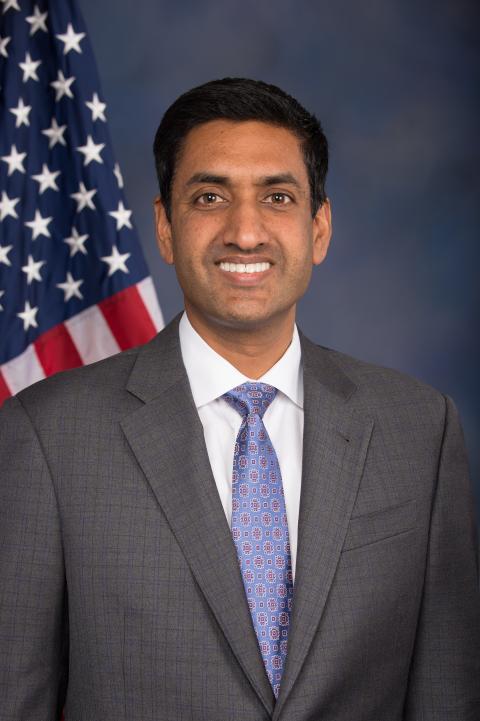
Ro Khanna is one of the most intellectually distinctive and nationally prominent members of Congress — a progressive Silicon Valley lawmaker, former Obama administration official, Stanford economics lecturer, and author whose career sits at the crossroads of technology, democracy, and economic justice. He was born in Philadelphia, Pennsylvania, in 1976, and earned a bachelor's degree in economics from the University of Chicago in 1998 and a J.D. from Yale University in 2001.
Both of his parents immigrated to the United States from India in the 1970s in search of opportunity and a better life for their children. His father is a chemical engineer and his mother is a substitute school teacher. Khanna has often cited his grandfather — who was active in Gandhi's independence movement, worked with Lala Lajpat Rai in India, and spent several years in jail for promoting human rights — as the foundational inspiration for his own commitment to public service.
After completing his law degree, Khanna worked as an attorney, then served as a Lecturer in the Department of Economics at Stanford University and as an Adjunct Professor at Santa Clara Law School. In 2009, President Obama appointed him to serve as Deputy Assistant Secretary at the U.S. Department of Commerce, where he organized clean technology trade missions and expanded the Green Embassy program, allowing American clean energy firms to showcase their products in U.S. embassies overseas.
Before winning his current seat, Khanna ran unsuccessfully in 2014 against incumbent Mike Honda in the old 17th District, a race that raised his profile significantly. He assumed office on January 3, 2017, and his current term ends on January 3, 2027. He represents California's 17th District, the heart of Silicon Valley in the southern area of the San Francisco Bay Area. He currently serves on the Committee on Armed Services, the Committee on Oversight and Government Reform, and the Select Committee on the Strategic Competition Between the United States and the Chinese Communist Party.
Khanna's legislative record is defined by an unusual ideological blend — a fierce progressive on economic and foreign policy issues combined with a deep enthusiasm for technology, manufacturing, and American competitiveness. He authored the Endless Frontier Act, which formed the basis for the sweeping CHIPS and Science Act signed into law by President Biden, ensuring the United States remains a leader in science and technology. As Chair of the House Oversight and Reform Environmental Subcommittee, he brought the CEOs of six major fossil fuel companies before Congress to testify under oath about climate disinformation for the first time in history, and played a key role in ensuring that key climate provisions remained in the Inflation Reduction Act.
On foreign policy, Khanna has been one of Congress's most consistent voices for military restraint, leading bipartisan efforts to end U.S. involvement in the Yemen war and challenging American military commitments overseas. He co-founded the NO PAC Caucus with Beto O'Rourke and Jared Polis, refusing all contributions from political action committees, and has introduced legislation to ban PAC contributions to members of Congress entirely. More recently, in February 2026, Khanna used his time on the House floor to publicly read the names of six individuals he said had been redacted from the Department of Justice's publicly released files related to Jeffrey Epstein, co-sponsoring the Epstein Files Transparency Act with Representative Thomas Massie.
Khanna is the author of two books: Entrepreneurial Nation: Why Manufacturing is Still Key to America's Future and Dignity in a Digital Age: Making Tech Work for All of Us. In his free time, he enjoys cheering for the Golden State Warriors, watching movies, and traveling. He calls Fremont home, and he and his wife Ritu have two young children. His combination of academic rigor, tech fluency, and progressive conviction has made him one of the most singular and closely watched figures in the Democratic Party — and a potential future candidate for higher office.